In Uscita
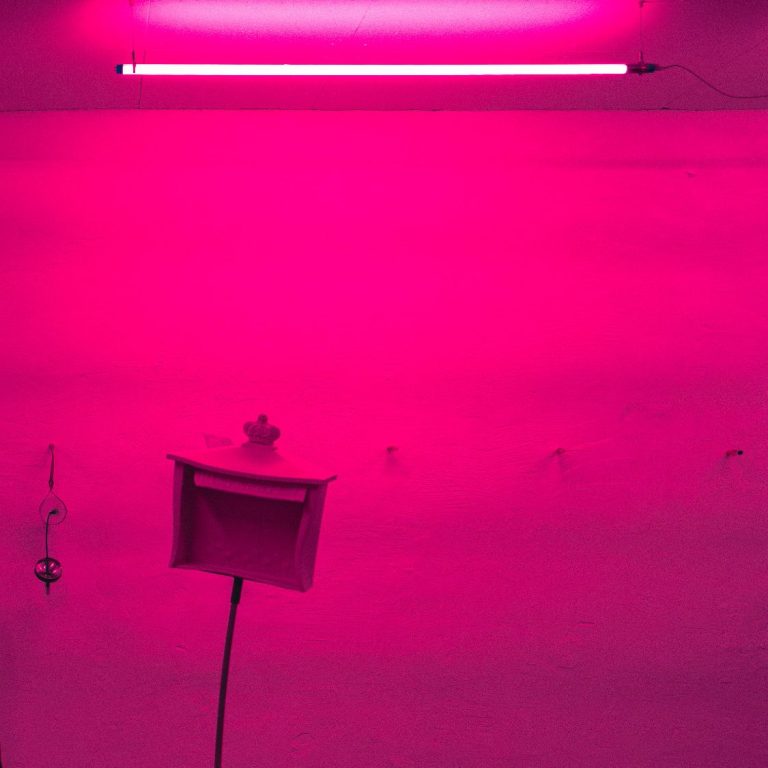
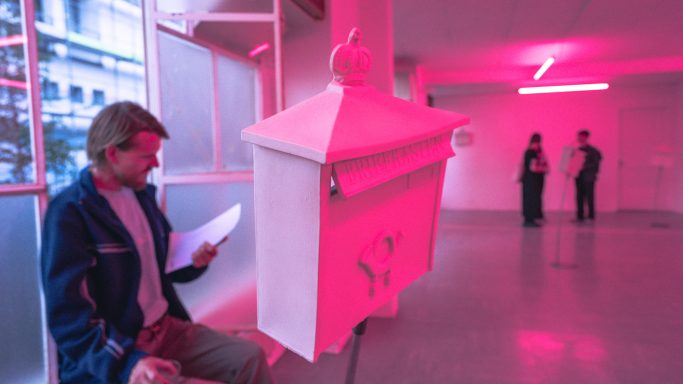
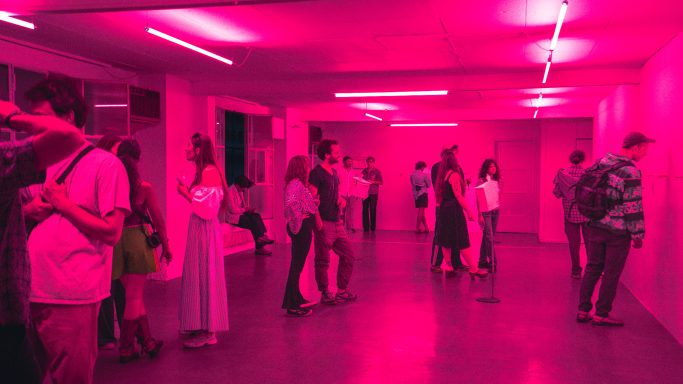
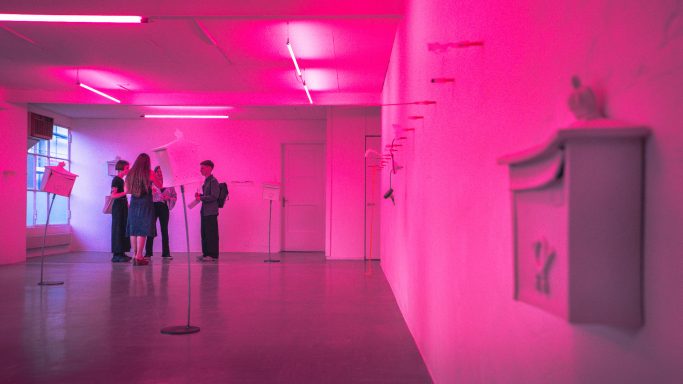
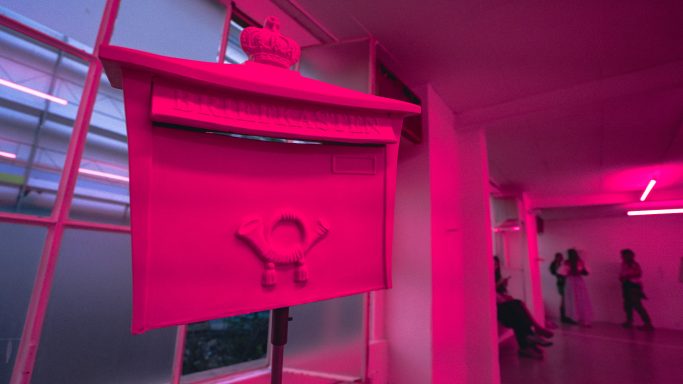
Sounds emerge from inside six porcelain letterboxes Whisper Whisper by Cristina Rüesch and Sophia Leitenmayer, mounted on the wall and floor on slightly flexible iron poles; there are six distinct instruments for each letterbox. We do not hear a melodic or recognizable harmonic sequence, nor—due to the timing discrepancies between the loops of the sound tracks—an orchestration. We hear a dialogue, more akin to natural speech than to a musical order, a sort of conversation, albeit—being devoid of any symbolic meaning—merely formal. Even the mailboxes, in their installation layout and in the slight movements of their curves caused by the bending of the iron poles, seem to evoke an anthropomorphic posture, a social pose. A relational semblance between subjects indicated by the concept of home, domicile, and postal address, further reinforced by the equation between individual and dwelling, as a sound emitted by a single instrument emerges from each mailbox. Indeed, it would seem that these mailboxes have become the mailboxes of many studio apartments, transforming from the quintessential collective object—a symbol of communication that has become a system—into a metaphor for the individual: for their isolation, within the marked spatial and temporal distance of the mailboxes; or even for their incommunicability, in the illiteracy and simultaneity of the sonic dialogue: the back-and-forth of epistolary communication (sequential par excellence) is in fact interrupted by the instruments talking over one another: The back-and-forth of written communication—sequential by nature—is in fact interrupted by the tools talking over one another, as in an instant chat where, as you send messages, you don’t have time to read what the other person is writing. The letter now appears as fleeting as oral communication, and in the bending of the letterboxes we begin to see a structural deformation, a crack, a bulge that heralds decomposition. Language no longer seems to be the home of man, but merely a container—perhaps empty—of which nothing remains but a fleeting aura, a whisper of a communication now worn out.
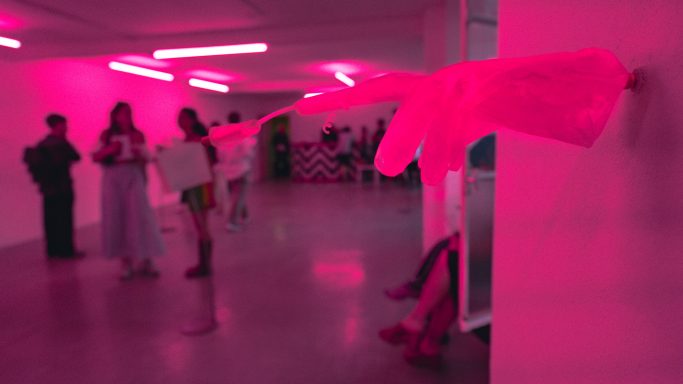
Added to the letterboxes on the wall are several objects: prosthetics, microphones, and other instruments cast in transparent resin, through which one can see the wall mount, a jack connector. Thus, in this transparency, the device camouflages its use value.
The instrument ceases to be a tangible intermediary, and that opacity of the medium—the now-outdated “message of the medium”—vanishes, leaving room for the support, we might say, for the medium of the medium. Perhaps the sounds of letterboxes, the message of communication—too stretched out, distant, epistolary—is constantly trying to find a microphone; it is constantly seeking a means of amplification capable of sharing that information (if it truly existed), to make that whisper intelligible (“Whisper Whisper”).
But the device already seems like a ghost of that communication. It seems that in a hypermedia world, there are no longer any prosthetics that can help us speak. Only a channel remains, a cable, the zero degree of the medium; a cordless phone that now appears filtered, protected. The medium as a condom, like the silicone interior of a male vibrator, a protection that leaves us only able to whisper, without ever truly being able to touch each other. Thus we live in safety thanks to that right distance between us and the penetrating violence of the connector protruding from the wall. We live in the safety of the other or from the other, more than in our own, when we can no longer speak to one another, and the potential of contact—even its latent violence—is minimized, covered up, reduced: contact preserved thanks to a further medium, a further obligatory step.
Lugano, April 7, 2025, written by curator Uriel Schmid Téllez
-italiano-
Dall'interno di sei bucalettere in porcellana Whisper Whisper da Cristina Rüesch e Sophia Leitenmayer, installate a muro e a pavimento su dei pali di ferro leggermente flessibili, escono dei suoni, sei strumenti distinti per ogni bu-calettere. Non sentiamo una sequenza armonica melodica o riconoscibile, come nemme-no, a causa degli scarti temporali fra i loop delle tracce sonore, un'orchestrazione. Sentiamo un dialogo, più simile al linguaggio naturale che ad un ordine musicale, una sorta di conversazione, seppure, essendo privata di qualsiasi significato simbolico, soltanto formale. Anche le bucalettere, nella loro disposizione installativa e nei piccoli movimenti delle curvature dovute alla flessione dei pali in ferro, sembrano richiamare una postura antropomorfa, una posa sociale. Una parvenza relazionale fra soggetti indicata dal concetto di casa, domicilio, recapito postale, ancora rafforzata dall'equazione fra individuo e dimora, nell'uscita da ogni bucalettere di un suono emesso soltanto da un singolo stru-mento. Sembrerebbe anzi che queste bucalettere siano diventate cassette postali di tanti monolocali, da oggetto collettivo per eccellenza, simbolo di una comunicazione diventata sistema, a metafora del singolo: della sua isolazione, nella segnata distanza spaziale e temporale delle bucalettere; o ancora della sua incomunicabilità, nell'analfabetismo e nella simultaneità del dialogo sonoro: il botta e risposta della comunicazione epistolare (sequenziale per eccellenza), è infatti interrotto dal parlarsi addosso degli strumenti, come in una chat instantanea in cui inviando messaggi non si fa a tempo a leggere ciò che scrive l'altro. La lettera appare ora volatile quanto la comunicazione orale, e nella flessione delle bucalettere cominciamo a vedere una deformazione strutturale, una crepa, un rigonfiamento che annuncia una decomposizione. Il linguaggio non sembra più la casa dell'uomo, ma solo un contenitore, forse vuoto, di cui non resta che un'aurea di passaggio, un sussuro di una comunicazione ormai logora.
Alle bucalettere si aggiungono poi a parete alcuni oggetti: protesi, microfoni e altri strumenti stampati in resina trasparente, attraverso cui si vede il supporto a muro, un connettore jack. Così, in questa trasparenza, il dispositivo mimetizza il suo valore d'uso.
Lo strumento smette di essere intermediario tangibile, e quell'opacità del mezzo, l'ormai vecchio "messaggio del medium", svanisce, lasciando spazio al supporto, vorremmo dire, al mezzo del mezzo. Forse i suoni delle bucalettere, il messaggio della comunicazi-one, troppo dilatato, lontano, appunto epistolare, sta continuamente cercando di trovare un microfono; sta continuamente cercando un mezzo di amplificazione in grado di condividere quell'informazione (se ci fosse davvero), per rendere intellegibile quel sussurro ("Whisper Whisper"). Ma l'attrezzo appare già come un fantasma di quella comunicazi-one. Sembra che non ci siano più protesi, in un mondo ipermediale, che possano aiutarci a parlare. Rimane solo un canale, un cavo, il grado zero del mezzo; telefono senza fili che ora appare filtrato, protetto. Il mezzo come preservativo, come l'interno in silicone di un vibratore maschile, una protezione che ci lascia solo bisbigliare, senza mai veramente poterci toccare. Cosi viviamo nella sicurezza grazie a quella giusta distanza fra noi e la violenza penetrativa del connettore che esce dal muro. Viviamo nella sicurezza dell'altro o dall'altro, più che della nostra, quando non possiamo più parlarci, e la potenzialità del contatto, persino la sua violenza in potenza è minimizzata, coperta, ridotta: contatto preservato grazie ad un ulteriore mezzo, un ulteriore passaggio obbligato.
Lugano, 7 aprile 2025, Uriel Schmid Téllez