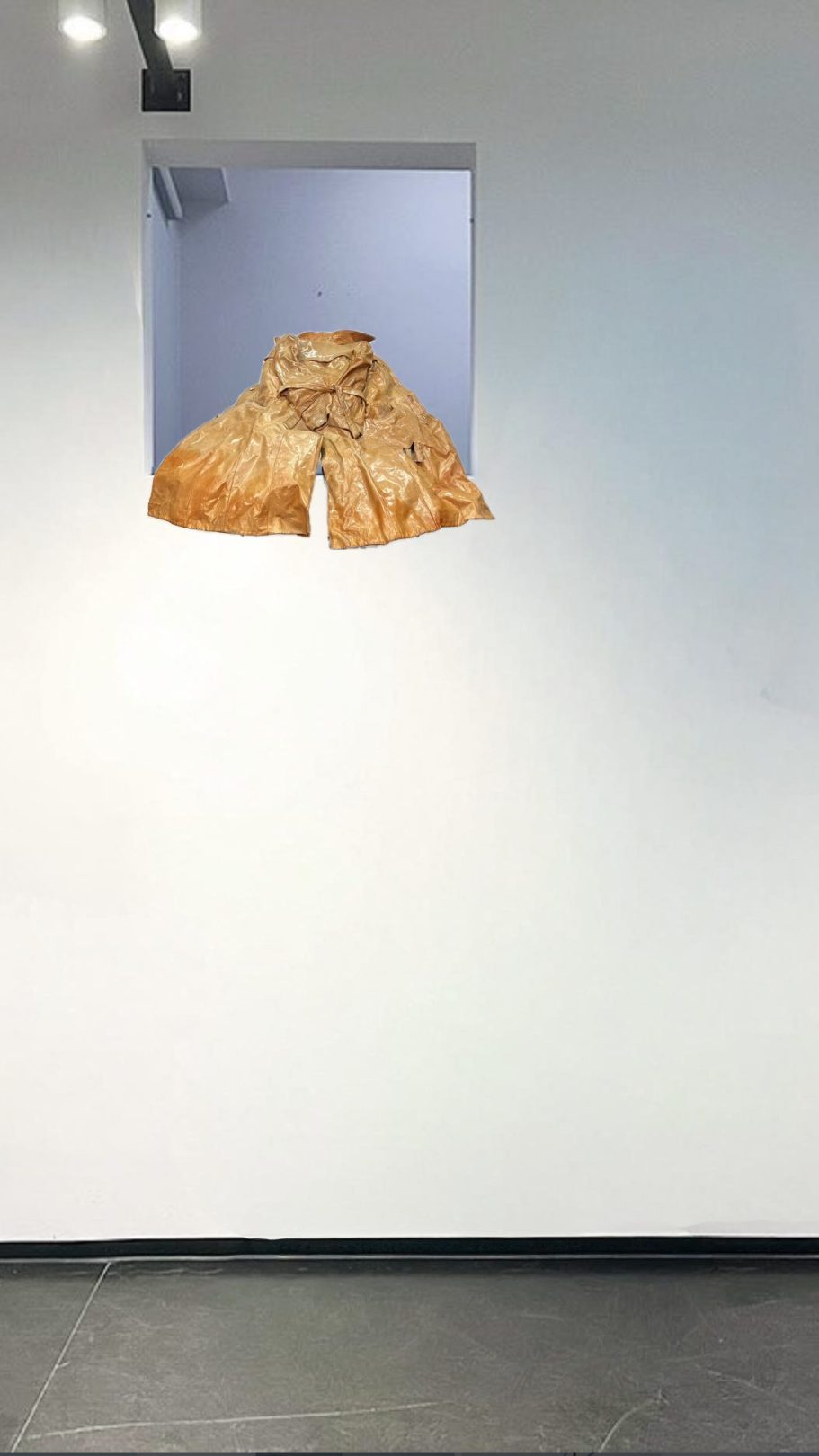
Archive Object No.1
Archive Object No. 1 explores the coat as a vessel of memory and as a form of potential monument. The starting point is two distinct historical and artistic references: the Monument to the Forgotten Coat on the Wiwilí Bridge in Freiburg and the coat in the archives of the Peršman Museum in Carinthia.
The bronze coat in Freiburg commemorates the at least 379 Jewish residents of Freiburg who were deported in October 1940. As a piece of clothing left behind, it marks the absence of those who were forcibly excluded from society. In my very first film, Zi-korn’ (2011), I explored this monument and its specific form of remembrance. In my latest film, Zbiramo Odpor (2026), which examines the archives of the Peršman Museum, the coat reappears as a tangible historical artefact. Embedded within the history of the Carinthian Slovenes’ resistance and that of the Sadovnik family, it highlights the connection between individual life stories, political persecution and collective memory. Today, the Peršmanhof is a place of remembrance and learning where the history of persecution and resistance is conveyed.
Archive Object No. 1 navigates between these two points of reference. I am interested in how history becomes inscribed in objects and how an object can become a testament without losing its original materiality and ambiguity. What distinguishes a garment in an archive from an artistic monument in public space? When does an object become a vessel of collective memory? And which stories remain invisible when archives, monuments and official historiography preserve certain experiences, whilst others are marginalised or forgotten?
The exhibition venue, kunstraum Braugasse in Hoyerswerda, lends these questions a particular socio-political urgency in 2026. The town is characterised not only by the profound structural change following the end of the GDR and the economic decline of the lignite industry, but also by the racist riots of September 1991. At that time, right-wing extremists, together with a large crowd, first attacked contract workers from Mozambique and Vietnam and subsequently refugees in their accommodation. The violence, which lasted for days, ultimately led to the evacuation of those under attack. Hoyerswerda thus became a symbol of racist violence in reunified Germany.
This history raises the question of remembrance not merely as a historical task, but also as a contemporary social one. Which people are recognised as part of a community, and whose presence is violently called into question? What traces do exclusion, persecution and resistance leave behind in a place? And how can we remember those whose experiences are in danger of disappearing from the collective memory?
Against this backdrop, Archive Object No. 1 can be understood as an exploration of a material practice of remembrance. The coat does not represent a closed chapter of the past, but rather opens up a space in which different stories of absence, violence, resistance and belonging intersect. In Hoyerswerda, the object takes on an additional significance: it highlights the responsibility to view memory not as a static preservation of the past, but as an ongoing engagement with the social conditions of the present. The archive thus becomes a place where history is not merely preserved, but where questions are also asked about which stories need to be told and for whom.